If you work with SAP logistics, the question is no longer whether to move from SAP WM to SAP EWM. The question is when and how. SAP has officially announced the end of support for SAP WM, and every organization currently running WM must plan its migration to EWM.
This guide provides a comprehensive comparison of SAP WM and SAP EWM, the official end-of-support timelines, migration strategies, and practical advice for consultants and businesses making the transition.
A Brief History
SAP WM (Warehouse Management) was introduced in the late 1970s as part of the Materials Management (MM) module. For decades, it served as the standard solution for managing warehouse storage locations, bin-level inventory, and basic goods movements. It is tightly integrated with the MM module and operates within the same ABAP stack.
SAP EWM (Extended Warehouse Management) was released in 2005 as a standalone product on the SAP SCM (Supply Chain Management) server. It was designed from the ground up to handle complex, high-volume, and highly automated warehouse operations that WM could not support. With the launch of SAP S/4HANA, EWM has been embedded directly into the ERP system, making it the only supported warehouse management solution going forward.
Side-by-Side Comparison: SAP WM vs SAP EWM
| Feature | SAP WM | SAP EWM |
|---|---|---|
| First Released | Late 1970s | 2005 |
| Platform | Part of MM module in ECC | Standalone or embedded in S/4HANA |
| Database | Any SAP-supported DB | SAP HANA (in-memory) |
| User Interface | SAP GUI only | SAP Fiori, ITS Mobile, RF framework, SAP GUI |
| Warehouse Structure | Storage type and storage bin (2 levels) | Warehouse, storage type, storage section, storage bin, aisle (multi-level) |
| Putaway Strategies | Fixed bin, next empty bin, bulk storage | All WM strategies plus slotting, dynamic bin determination, layout-oriented strategies |
| Picking Strategies | FIFO, LIFO, partial quantities | All WM strategies plus wave management, multi-order picking, pick-by-voice, pick-by-light, pick path optimization |
| Labor Management | Not available | Built-in with ML-based predictive labor planning |
| Material Flow System (MFS) | Not available | Direct PLC communication for conveyors, sorters, AS/RS |
| Yard Management | Not available | Built-in trailer and dock door management |
| Cross-Docking | Very limited | Full support (planned, opportunistic, push, pull) |
| Slotting Optimization | Not available | Built-in for optimal product placement |
| Wave Management | Not available | Full support for grouping deliveries into waves |
| Task Interleaving | Not available | Assigns putaway task on return trip from pick zone |
| Handling Units | Basic support | Full hierarchy (pallet > case > item) with nested tracking |
| TM Integration | Not available | Native integration with Transportation Management |
| Development Status | Development stopped; no new features | Active development with quarterly releases through 2040+ |
Official End-of-Support Timeline
SAP has published clear deadlines for SAP WM deprecation. These are the dates every SAP customer needs to know:
| System | WM Support End Date | Extended Maintenance |
|---|---|---|
| SAP S/4HANA | December 31, 2025 (compatibility mode ends) | No new features; critical fixes only |
| SAP ECC | December 31, 2027 (mainstream maintenance) | Extended maintenance until December 31, 2030 (critical fixes only) |
| RISE with SAP | Extended deadline until 2030 | Migration to EWM required afterward |
Why SAP Is Phasing Out WM
The decision to deprecate WM is not arbitrary. There are fundamental architectural and business reasons:
- WM was designed in the 1970s for simple, low-volume warehouses. Modern warehouses need automation, AI, and real-time visibility that WM cannot provide.
- No automation support: WM has no Material Flow System (MFS) for controlling conveyors, sorters, or robots. Companies using WM need expensive middleware to connect to automation hardware.
- No labor management: WM cannot track worker productivity, predict labor demand, or optimize task assignments. This is table stakes for modern warehouse operations.
- Limited scalability: WM struggles with high transaction volumes. EWM's HANA-based architecture handles millions of stock movements per day.
- S/4HANA clean core strategy: SAP is simplifying S/4HANA by removing legacy components. WM is one of the modules being replaced by modern equivalents.
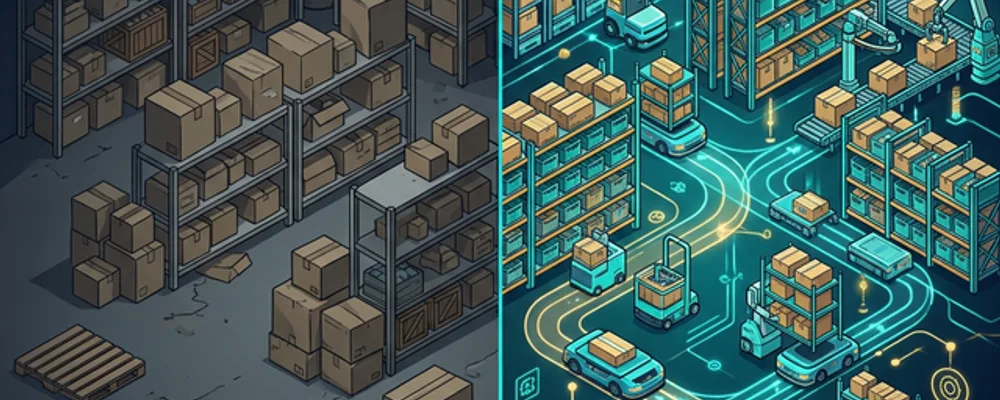
WM vs EWM - Core Capability Contrast
SAP WM
- 2-level warehouse structure (storage type, bin)
- SAP GUI only
- Basic FIFO/LIFO picking
- No labor management
- No MFS or automation support
- No yard management
- No wave or task interleaving
- Development frozen; end of support 2025-2027
SAP EWM
- Multi-level warehouse structure (5+ levels)
- SAP Fiori, ITS Mobile, RF, SAP GUI
- Wave management, pick-by-voice, pick path optimization
- Built-in ML-based labor planning
- Direct PLC/MFS integration for automation
- Built-in yard and dock door management
- Full task interleaving and slotting optimization
- Active development with quarterly releases through 2040+
Migration Strategies: WM to EWM
There are several approaches to migrate from SAP WM to EWM, depending on your organization's complexity and timeline:
| Strategy | Description | Best For |
|---|---|---|
| Brownfield | Technical migration to S/4HANA with embedded EWM, preserving existing processes | Companies wanting minimal disruption |
| Greenfield | Complete redesign of warehouse processes using EWM best practices | Companies wanting to optimize from scratch |
| Big-Bang | Simultaneous migration of S/4HANA and EWM in one phase | Smaller organizations with fewer warehouses |
| Gradual | Phased transition: migrate to S/4HANA first, then implement EWM warehouse by warehouse | Large organizations with multiple warehouses |
LTMC (Legacy Transfer Migration Cockpit) for data migration tasks during the WM-to-EWM transition. For EWM warehouse configuration, key transactions include /SCWM/PRDI for product master and /SCWM/MON for the warehouse monitor.Common Migration Challenges
- Custom code: WM customizations (Z-code) cannot be directly migrated. Most need to be replaced with standard EWM functionality or rebuilt using EWM's extensibility framework.
- Data mapping: WM and EWM use different data models. WM's storage type/bin structure must be mapped to EWM's more granular warehouse structure.
- User training: EWM has a completely different user interface (Fiori, ITS Mobile). Warehouse operators and planners need retraining.
- Integration testing: All interfaces with MM, SD, PP, and third-party systems must be retested with EWM.
- Parallel run: Most organizations run WM and EWM in parallel during migration to validate accuracy before cutover.
What About SAP Logistics Management?
In 2025, SAP announced SAP Logistics Management, a new lightweight solution for smaller, decentralized warehouse operations with basic functions and minimal automation. This is not a replacement for EWM. It fills the gap for locations that do not need full EWM functionality (for example, a small parts warehouse at a plant). The positioning is:
- SAP EWM: Complex, high-volume, automated warehouses (distribution centers, 3PL facilities)
- SAP Logistics Management: Simple, low-volume locations (plant warehouses, spare parts stores)
What SAP Consultants Should Do Now
- If you are a WM consultant: Start learning EWM immediately. The WM skill set is becoming obsolete. Focus on embedded EWM in S/4HANA, which is the most common deployment for new projects.
- If you are a fresher: Skip WM entirely. Learn EWM from the start. There is no career benefit to learning a technology being phased out.
- If you are advising a client: Any customer still on WM should have an EWM migration roadmap. The cost of waiting increases every year as the talent pool for WM shrinks.
Key Takeaways
- SAP WM support ends December 31, 2025 (S/4HANA) and December 31, 2027 (ECC mainstream)
- SAP EWM is the only actively developed warehouse management solution in the SAP ecosystem
- EWM offers 15+ capabilities that WM simply does not have: MFS, labor management, yard management, slotting, cross-docking, wave management, task interleaving, and more
- Migration options: Brownfield, Greenfield, Big-Bang, or Gradual, depending on organization size and complexity
- SAP Logistics Management is a new lightweight option for simple warehouses, not a replacement for EWM
- For consultants: EWM is a must-learn skill. WM expertise alone will not sustain a career beyond 2027
Key Takeaway
SAP WM is end-of-life. Whether you are a consultant, a business stakeholder, or an IT decision-maker, the time to act on an EWM migration plan is now - not after the support deadlines pass. EWM delivers capabilities that WM was never designed for, and organizations that delay migration face rising costs, shrinking talent availability, and zero support from SAP.