One of the most agonizing decisions a junior SAP consultant faces early in their career is choosing between an Implementation Project and an Application Management Services (AMS) / Support Role. Senior managers often pull freshers in both directions, making it incredibly difficult to know which path will maximize long-term career growth, salary potential, and work-life balance.
The truth is, both paths are incredibly valuable, but they forge entirely different types of professionals. This interactive guide breaks down the brutal reality of both career tracks, helping you align your specific personality, risk tolerance, and financial goals with the correct SAP environment.
The SAP Implementation Consultant (The Architect)
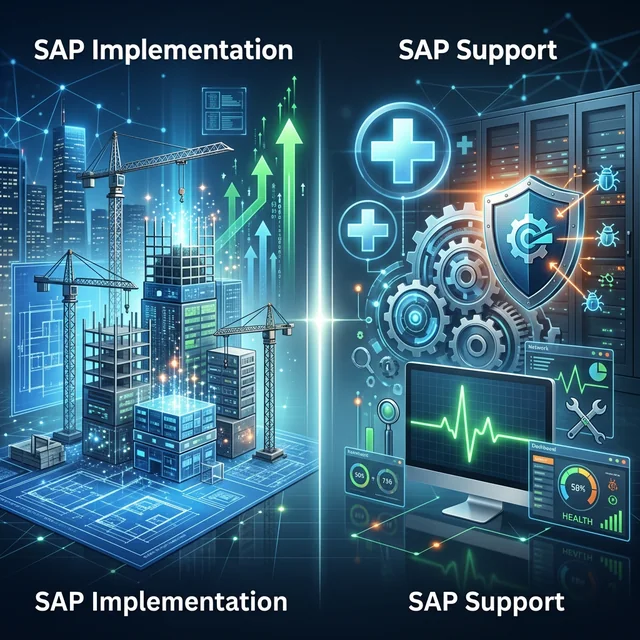
An implementation project is the process of building a brand-new SAP system (like S/4HANA) from scratch or migrating a massive legacy system over a multi-year timeline. You are not fixing something that is broken; you are constructing the foundation.
The Reality of an Implementation Project
- The Mindset: You must be highly consultative. You spend hours sitting in conference rooms with C-level executives and warehouse managers, asking them exactly how their business operates today, and designing a blueprint for how it should operate tomorrow.
- The Pressure Cooker: Implementations are infamously stressful. End-users naturally resist change. Timelines are aggressive. If a critical gap exists between the business requirement and the standard SAP configuration, you must design complex custom architectural solutions rapidly.
- The Skillset: You will master deep customization logic, master data migration strategies (
LSMW/LTMC), and the exact sequential configuration steps required in theSPROimplementation guide.
The Pros and Cons of Implementation
| The Major Advantages | The Brutal Disadvantages |
|---|---|
| High Market Value: S/4HANA Implementation experience is arguably the highest-paying skill in the SAP ecosystem. | Severe Burnout: 60-hour workweeks are incredibly common during the "Go-Live" phase. You are often expected to work weekends to hit milestone deadlines. |
| Business Architecture Skills: You learn exactly how global supply chains operate at a strategic level, making you an excellent candidate for Solution Architect roles later. | Constant Travel: Historically, consultants spent Monday through Thursday living in hotels (though this has decreased post-pandemic, major global rollouts still require intense on-site presence). |
| Creative Configuration: You get to build solutions from a blank canvas. If an elegant design works, your name is attached to that success. | Imposter Syndrome: You are often thrown into completely unfamiliar industries (Pharma one year, Retail the next) and expected to be the absolute authority in the room instantly. |
The SAP Support Consultant (The Surgeon)
Once the exhausting implementation project is finished, the architects leave, and the system is handed over to the Application Management Services (AMS) team. Support consultants inherit the live, breathing system. Their job is to keep the enterprise running smoothly while a billion dollars of revenue flows through it daily.
The Reality of an SAP Support Role
- The Mindset: You are a highly specialized detective. A user submits an incident ticket stating: "I cannot post a Goods Receipt, the system throws an obscure ABAP dump error." You do not get to rebuild the system; you must meticulously trace the exact line of code or missing configuration setting causing the failure without breaking anything else.
- The SLA Game: Support is strictly governed by Service Level Agreements. If a Priority 1 issue occurs (the main factory production line is halted because SAP cannot print standard labels), you have exactly two hours to diagnose and resolve the issue before massive financial penalties hit your consulting firm.
- The Skillset: You master advanced debugging techniques, IDoc failure resolution, batch job monitoring, and deep root-cause analysis. You see the massive, catastrophic mistakes the implementation team made, and you learn precisely what NOT to do.
The Pros and Cons of Support
| The Major Advantages | The Brutal Disadvantages |
|---|---|
| Excellent Work-Life Balance: Support is highly predictable. When your 8-hour shift ends, you mathematically hand off tickets to the offshore team. Weekends are generally entirely yours. | Slightly Lower Compensation: While still very lucrative compared to non-IT roles, pure AMS support consultants generally cap out at slightly lower salary ceilings than specialized S/4HANA Implementation Architects. |
| Deep Analytical Skills: You become a master troubleshooter. You understand the profound ripple effects of tiny configuration changes far better than most implementation consultants. | Repetitive Monotony: Resetting passwords, unlocking users, and resolving the same basic master data errors repeatedly can become incredibly boring after two years. |
| Job Security: Companies will delay a new implementation during a recession, but they will never fire the support team keeping their live production servers running. Support is practically recession-proof. | Pigeonholing: If you stay in support for 7 years without touching a new implementation, migrating into an architectural role later becomes significantly more difficult, as your skillset may stagnate on older ECC versions. |
Side-by-Side Role Comparison
Support Role
- Inherit a live, running SAP system
- Diagnose tickets and resolve incidents within SLA windows
- Master IDoc failures, ABAP dumps, and batch job errors
- Predictable hours with structured shift handoffs
- High job security - even during recessions
- Risk: skillset can stagnate on legacy ECC versions
Implementation Role
- Build a brand-new SAP system from a blank canvas
- Design architecture using
SPROconfiguration blueprints - Drive data migration with
LSMWandLTMC - Intense pressure during Go-Live with extended hours
- Highest salary ceiling in the SAP ecosystem
- Risk: burnout and imposter syndrome in unfamiliar industries
The Verdict: Which Path Should You Choose?
The optimal SAP career is not choosing one over the other permanently; the master strategy is blending them strategically.
The Strategy for Freshers (0 - 3 Years)
If you have zero experience, beg for a Support role. Attempting to implement a system you have never actually used is a recipe for disaster. Spending two years resolving tickets forces you to understand how standard business users actually interact with Fiori. You see where standard SAP logic fails, how complex custom enhancements are written, and why poorly designed architecture causes catastrophic daily problems. Earning your "stripes" in the trenches of AMS makes you a vastly superior architect later.
The Strategy for Mid-Level (3 - 7 Years)
Once you are highly proficient at solving problems, you must aggressively transition into Implementation Projects. This is where your salary fundamentally jumps. Leverage your deep troubleshooting knowledge to design robust, clean, scalable architectures that will not plague the future support team with constant P1 incidents.
The Strategy for Seniors (7+ Years)
At the senior level, your career diverges based on personal goals. If you desire massive compensation, frequent travel, and high prestige, pursue the Global Solution Architect track leading massive multi-national S/4HANA rollouts. If you value absolute stability, leadership, and time with your family, pursue an AMS Service Delivery Manager route, overseeing the profitability and technical health of multiple steady-state client landscapes.
Ultimately, a master consultant respects both disciplines. The architect builds the ship, but the support engineer ensures it survives the storm.
Key Takeaway
Start in Support to build a deep operational foundation, then pivot to Implementation to maximize your salary ceiling. The consultants who have done both are the ones who design systems that never come back as P1 tickets - and those are the professionals every firm competes to hire.