Supply chain planning is entering a new era. In 2026, AI is no longer just a tool that runs in the background - it's an active participant in planning decisions. Welcome to Agentic AI: autonomous AI agents that plan, decide, and act within defined boundaries, while human planners focus on strategy and exceptions.
SAP has positioned SAP IBP at the center of this shift. With Joule integration, embedded generative AI, and autonomous planning agents, the platform is evolving from a planning tool into an AI-driven decision-making environment.
This guide covers what Agentic AI is, how it works in SAP IBP, the business impact, and what it means for your career.
What Is Agentic AI?
Agentic AI refers to AI systems that can perceive, reason, plan, and act autonomously to achieve specific goals - without requiring step-by-step human instructions. Unlike traditional automation (which follows rigid rules) or copilot AI (which assists humans), agentic AI makes decisions independently within guardrails set by humans.
| AI Maturity Level | What It Does | Example in IBP |
|---|---|---|
| Rule-Based Automation | Executes predefined rules | Auto-run MRP at 6 AM daily |
| Predictive Analytics | Forecasts outcomes from historical data | ML-based demand forecasting |
| Copilot AI | Assists humans with suggestions | Joule summarizes planning run results |
| Agentic AI | Acts autonomously within defined boundaries | AI agent detects supplier delay, auto-reallocates inventory, adjusts production schedule, and notifies stakeholders |
How Agentic AI Works in SAP IBP
SAP is reorienting IBP around three core principles for the agentic era:
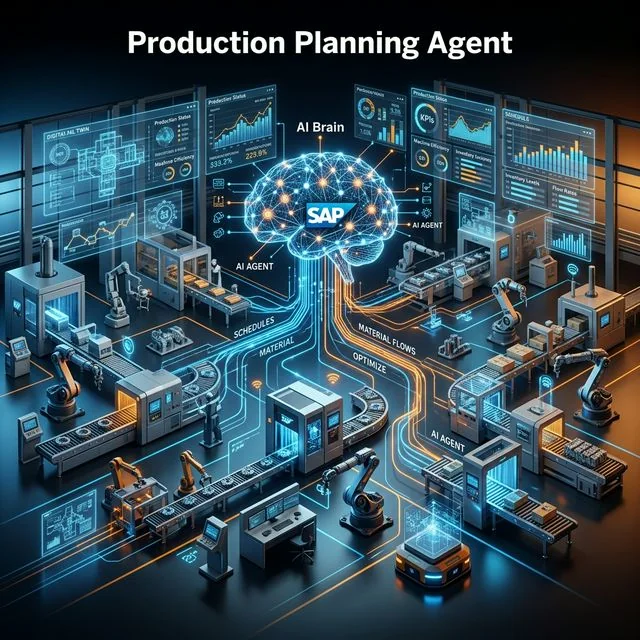
- Automation via AI agents: Autonomous agents that execute thousands of micro-decisions continuously - recalibrating plans, reallocating resources, adjusting for risks
- End-to-end process orchestration: AI agents operate across the entire planning chain (demand - supply - inventory - logistics) rather than in isolated modules
- Real-time contextual analysis: Agents analyze live data streams and respond to changing conditions in near-real-time
What AI Agents Do in Practice
| Supply Chain Event | Traditional Response | AI Agent Response |
|---|---|---|
| Supplier delays shipment by 2 weeks | Planner manually identifies impact, calls alternate suppliers | Agent auto-identifies at-risk orders, switches to backup supplier, adjusts production schedule, notifies procurement |
| Demand spike detected via POS data | Planner reviews next morning, adjusts forecast | Agent updates forecast within hours, triggers replenishment, adjusts transportation plan |
| Machine breakdown at key plant | Production scheduler redistributes orders manually | Agent reallocates production to alternate plants, re-prioritizes orders by customer tier, updates delivery promises |
Joule: SAP's AI Copilot in IBP
Joule is SAP's generative AI copilot, integrated directly into IBP. It serves as the conversational interface between planners and the planning system:
- Natural language queries: "Show me the top 10 SKUs with the highest forecast error this month"
- Planning run summarization: Joule reads planning run logs and generates plain-language summaries with key exceptions highlighted
- Data retrieval: "What's the current inventory position for Product X at Location Y?"
- Scenario comparison: "Compare the base case vs. recession scenario for Q3 revenue impact"
Fact: SAP reports approximately 25% improvement in planner productivity when using Joule for analyzing planning results.
The Business Impact - By the Numbers
Early adopters of AI-driven supply chain planning report significant measurable outcomes:
| Metric | Improvement |
|---|---|
| Forecast accuracy | Up to 20% improvement |
| Logistics costs | 15% reduction |
| Inventory levels | 35% reduction |
| Service levels vs competitors | 65% improvement |
| Supplier onboarding time | 50% reduction |
| Unplanned equipment outages | 30% reduction (predictive maintenance) |
| Lead times during disruptions | 25% shorter |
Gartner projects that by 2028, 50% of all planning decisions will be shared between humans and AI agents.
The Human-Plus-Machine Paradigm
Agentic AI does not eliminate the planner role. Instead, it fundamentally reshapes it:
| AI Agent Handles | Human Planner Handles |
|---|---|
| Thousands of daily micro-decisions (rebalancing, replenishment) | Strategic decisions (new market entry, capacity investments) |
| Real-time data analysis and pattern detection | Stakeholder communication and alignment |
| Exception flagging and root cause identification | Exception resolution and trade-off decisions |
| Routine report generation and scenario comparison | Governance, trust validation, and ethical oversight |
The Risk of Not Adopting
Industry analysts warn that companies not adopting native AI by 2026 face:
- 25% higher operational costs vs AI-enabled competitors
- 40% less supply chain resilience during disruptions
- Slower response times to market shifts, competitive moves, and customer demands
What This Means for SAP IBP Consultants
- Learn Joule: Conversational AI is now part of every IBP implementation
- Understand AI governance: Designing decision rights, escalation protocols, and trust boundaries is a new consultant skill
- Data quality becomes critical: AI agents are only as good as the data they consume - helping clients clean and harmonize master data is more important than ever
- The planner role evolves: Consultants must help clients redesign planning processes for human-plus-machine collaboration
Key Takeaways
- Agentic AI enables autonomous planning agents that perceive, decide, and act within defined guardrails
- SAP IBP is evolving around automation via AI agents, end-to-end orchestration, and real-time contextual analysis
- Joule provides conversational access to planning insights with ~25% productivity improvement
- Early adopters report 20% better forecasts, 35% less inventory, and 65% higher service levels
- By 2028, Gartner predicts 50% of planning decisions will be human-AI shared
- Companies that delay risk 25% higher costs and 40% lower resilience
Key Takeaway
Agentic AI is not a future concept for SAP IBP - it is here in 2026. Planners and consultants who invest now in understanding AI agents, Joule, and AI governance will be positioned to lead the next wave of supply chain transformation. The question is not whether to adopt, but how fast to scale.
Next Step: Explore our SAP IBP Training - learn how AI is reshaping supply chain planning careers